 |
I
cradle
you.

|
I
cradle
you.
It all started with a pair of argyle socks:
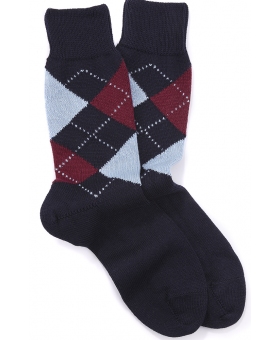
The first time I heard the word for this diamond pattern was in high school. Forgive me; I grew up ignorant of fashion and feet. For about a week afterwards, “Argyles!” became my exclamation of choice for anything new or surprising. “Argyles!” swiftly morphed into the more pronounceable “argles:”
Parents: How was your day today?
Me: Argles… (I’m tired and I don’t want to talk about it).
Imagined little sister: Are we there yet? Are we there yet?
Me: Argles! (You’re so annoying you don’t even know. Just stop)
Mom: I’m feeling under the weather today. Must have come down with a cold.
Me: Argles. (That sucks, doesn’t it?)
Argles spawned Blargles! (stubbed tow or a surprise jet of cold water in the shower) and Shmargles!? (Really? Again?). It’s the perfect word for the curmudgeon in all of us. Feel free to adopt or create your own variations.
Do you have pet words? What’s their story?

I’m investigating the boundary between work – what you do until you quit – and what Lewis Hyde in The Gift calls labor – what you do until it’s finished. (Notice the change in pronouns). Recently, I’ve started writing projects with the intent to work on them for 45 minutes and then quit, only to discover that I’m so excited about writing that blog post or revising my next chapter that I’ll finish it, no matter how long it takes. What changed?
Let’s start with the baseline of boring old work. Often, when I’m working on something for a spell, I stop because my productivity peters out: either because doing the task is hard, or because knowing what to do next is hard. The “tipping point” when timed work becomes labor has do with conceptualizing my task in enough detail to know the sequence of actions to take. Suddenly, all I have to do is my task, and I can stop thinking about what to do or how to do it. It feels like I’m almost possessed by a plan. I give up to the goal. And the work gets done.
According to Stephen King’s On Writing, Anthony Trollope wrote for exactly two and a half hours each morning before work – no more, no less (p 147). That’s the clock approach. Being possessed by an idea is the demon approach. What is your preferred habit of working – clocks or demons?


I am singing,
I am still
singing.
I am still, singing;
I am still.
I am still singing!
I am singing —
still.

March 10, Hexham, UK
At Hadrian’s wall today, I shed a tear of joy. For the voluminous blue sky, the gigantic wall’s invitation to play within it, my happiness at having finally found the the promise of the tour fulfilled. But it was not just that — it was perfect, complete contentment with myself and everything here.
Today was elusively the best day yet on tour, from the way our wonderful hosts Ruth and Mike at Lowlucken’s hugged every last one of one us when we said goodbye, to this moment of lying among the high crags at sunset.

/* Style Definitions */
table.MsoNormalTable
{mso-style-name:”Table Normal”;
mso-tstyle-rowband-size:0;
mso-tstyle-colband-size:0;
mso-style-noshow:yes;
mso-style-parent:””;
mso-padding-alt:0cm 5.4pt 0cm 5.4pt;
mso-para-margin:0cm;
mso-para-margin-bottom:.0001pt;
mso-pagination:widow-orphan;
font-size:10.0pt;
font-family:”Times New Roman”;}

On the road from Lowlucken’s Organic Farm, March 10, 2010
We are all playing hide and seek with Real Life. We talk of jobs and appartments as if they were secrets, speaking in whispers so that it can’t hear us. We respond to job postings on the sly. We worry about What Next in moments stolen from our schedule, while tossing under our the covers, where we think it can’t catch us. That is why we travel so much, piling quickly into the van, hurrying and stumbling over each other so that real life won’t notice our departure. He has agents everywhere, in glasgow and across the UK. His network spans continents and his welldressed agents operates without remorse. We can’t stay too long in any one place lest they catch us.
Most of us, if caught, would quiver. Would blanche and admit lingering insecurity and try to patch up the the accusation (spoken with the familiar jocularity of an old friend) that we had been avoiding it. But Mia would laugh. Over her two years off, she confides, while sapping and blacksmithing and milking sheep, she has earned not a handful of dollars. But she has earned milk, good goatsmilk, and according to Mia she would take goatsmilk over dollars any day. So Mia would laugh at real life’s boned face in its black cowl, and into it’s hungrylooking fingers she would place a glass jar of fresh milk.
Me, I try to extend a friendly hand to real life even while trying to escape from it. Knowing that with his mutts nose and falcolns eyes he will track my trail eventually, i try to blackmail the blackmailer. I do dishes in hosts’ houses, even when our hosts have a dishwasher. (Real life admires goid work and clean bowls). Laundry cures the blues, and sometimes I treat myself to a good dose of making sandwiches. I stuff three foiled bundles of pita, peanut butter, and apple slices into my backpack: sandwich security. Should real life come busting into our van, I will give him a sandwich, my offering, and he will not hurt me.

Hey folks!
Sorry for the infrequency of these blog posts. Because we spend a lot of days traveling, concerting, eating, singing, and getting lost or nearly run over in strange countryside side streets, it’s been hard to find time to write. Nevertheless, I’ve been having great fun on the UK leg of the tour, and finding touches of home in the strangest places — for example in the warm welcomes of the farmers at a nearby market in Queen’s Park in Glasgow.
My new writing solution is to tap out posts on my iPod while riding in the van. Here’s one from a couple of days ago, when we were riding off to Manchester:
Yesterday after an evening workshop we went to our first English pub, the Duke’s. It looked like the inside of a nice hotel with conservatively striped crimson wall paper, gilt framed mirrors, and a wood stove helping to warm us up where we sat by mahogany tables. At the bar I ordered a Shropshire gold, a mild pale brew that almost overcame my distaste for beers. I sat next to an young English couple, one of whom was studying forensic science in college, the other of whom was taking a gap year before going off to university. On a pop culture note, the forensic scientist told me that the TV show glee has just made it to England. And the English have a special holiday called Red Nose Day every other March: a day when all sport red noses and act silliy to benefit charity.
I had such wonderful vegetarian hosts here; it’s so nice to be in a house with young kids, energetic puppies, and parents who laugh at each others’ jokes (or groan knowingly, as the case may be). I shared with Molly a taste for garlic, with Aeife an interest in swimming, and with a Liam a love off instruments. (He played about five.) I need to learn more languages and more instruments!
So many if my sentences here begin with it’s so nice! Or look at that! I suppose I’m noticing and enjoying the words, the accent, the sheep we pass by on the highway. Lynn looks at me when I say these things and sort of smiles and nods in a doleful way. That dampless enthusiasm again. Will, when I lope around the Steiner school yard in the morning before two hours of driving in the van, calls me a leprechaun. I wish I had someone to share these enthusiasms with as fully as we share our music on stage. (But hey — I’ve been told that when I’m not around, all confess to actually enjoying my puns. It’s more bark than bite when Will jokes about reinstating his policy of punches for puns).
I’m looking forward to Glasgow tomorrow. I’m sorry that my postings have been so rare, but time has been spare, and it’s hard to escape the feeling that writing takes me away from all these wonderful experiences. So I’m typing this out on my iPod as we drive to Manchester and discuss the horses we see on the side of the road. (Please forgive the wigliness of spelling, capitalization, and such). I’m loving England so far. I’ll let you know, when I have the chance, what I think of Glasgow!

The forest was also home to Jake, who was a couple of weeks older than Arabella and already had a reputation as a trickster. One day, Jake had simply disappeared from the forest. When he didn’t return that evening, or the next, or the next, the elders sent out a search party to look for the red-flecked ruffian. Finally, on the evening of the fourth day, Jake barged into the elders’ house with a laugh, telling the assembled greywhiskers how much fun it was to watch all the cats looking for him. It turned out that Jack had climbed a tree and thought it would be funny not to come down.
In addition to being a trickser, Jake had a reputation as a showman, which everycat knew came straight from his elder brother. Jake’s elder brother had a meow that carried from one end of the dell to the other, and Jake wanted his meow (which he called his “roar”) to be just as gigantic. To the annoyance of everycat who went to bed early, Jake practiced his roar late into the evening. So Jake’s roar came to be pretty fierce.
One day, Jake the trickster and the showman decided to have some fun at Arabella’s expense. He climbed a tree near the road in the middle of the forest, and waited for her to approach. Soon enough, little grey Arabella came to the side of the road and stopped to look both ways. When Jake saw her from his perch atop the tree, he gathered up all his might and roared. GROOM!!!! His roar resounded across the forest.
Arabella skittered. She heard a sudden GROOM!!! from her left , and remembered that her mom had told her not to cross the road if she heard such a thing. But all Arabella saw down the road was trees and bees and tracks in the mud. There was nothing suspicious. As she looked probingly into the distance, Arabella wondered what she should do.
Meanwhile, Jacob scampered down from his tree on Arabella’s left and scampered up a tree on Arabella’s right. This was quite fun, he thought. From a branch on Arabella’s right he puffed out his chest and let out another roar. GROOM!!! His roar resounded across the forest.
Arabella nearly jumped out of her whiskers. First left, now right – the GROOM!!! was everywhere, yet seemed to come from nowhere. Despite her mom had said, the road seemed safe. Arabella pondered her dilemma. Should she cross the road, or not?

 Melts in Your Mind